In 2023 (1402 in the Iranian calendar), due to my engagement as a lawyer in several companies, I noticed a serious contradiction in the court rulings regarding damages for delayed payment of workers' claims. I reported this issue to the respected Head of the Supreme Court and the Prosecutor General of Iran.
Generally, based on an incomplete induction I had conducted, the appellate courts of Tehran Province had four different approaches to the starting point for calculating damages for delayed worker claims:
Some courts (like Branch 44) did not fundamentally consider workers' claims as "debt" and did not deem the worker entitled to damages.
Some (like Branch 62) considered the starting point to be the time the worker's claim was established.
Some (like Branch 35) used the date of issuance of the Dispute Resolution Board's verdict (the final judgment of the Labor Department) as the criterion.
Some (like Branch 56) considered the starting point to be the time the writ of execution was issued in the justice system.
What was the Prosecutor General's opinion?
Meanwhile, the opinion of the respected Prosecutor General of Iran, which was also read in the session of the General Board, was very precise, equitable, and similar to the opinion of Branch 62 of the Appellate Court. Citing the appearance of Article 522 (of the Iranian Civil Procedure Code), he declared the starting point of the worker's entitlement as the "date of demand" (in the worst-case scenario, the date the petition was submitted to the Labor Department). This view was consistent with economic and legal realities.
What did the majority of Supreme Court judges decide?
Unfortunately, the judges of the General Board of Iran's Supreme Court took a different view in Precedent-Setting Judgment 858 and determined the starting point for calculating damages to be the "date of finality of the Labor Department's verdict," similar to Branch 35 of the Appellate Court.
Critique of the Supreme Court Judges' Approach:
This decision, although it accepts the principle of awarding damages (unlike the ruling of Branch 44), is highly criticizable from the perspective of justice and the protection of workers' rights:
The legislator's goal in Article 522 is to compensate for the decrease in the value of the creditor's money due to the debtor's refusal to pay. In Iran's current inflationary conditions, the review process in the diagnostic and dispute resolution boards of the Labor Department often takes more than a year. According to Judgment 858, the worker will not receive any compensation for the severe depreciation of their money during this entire long period, which was at least 32% according to the official inflation rate in 2024 (1403 in the Iranian calendar).
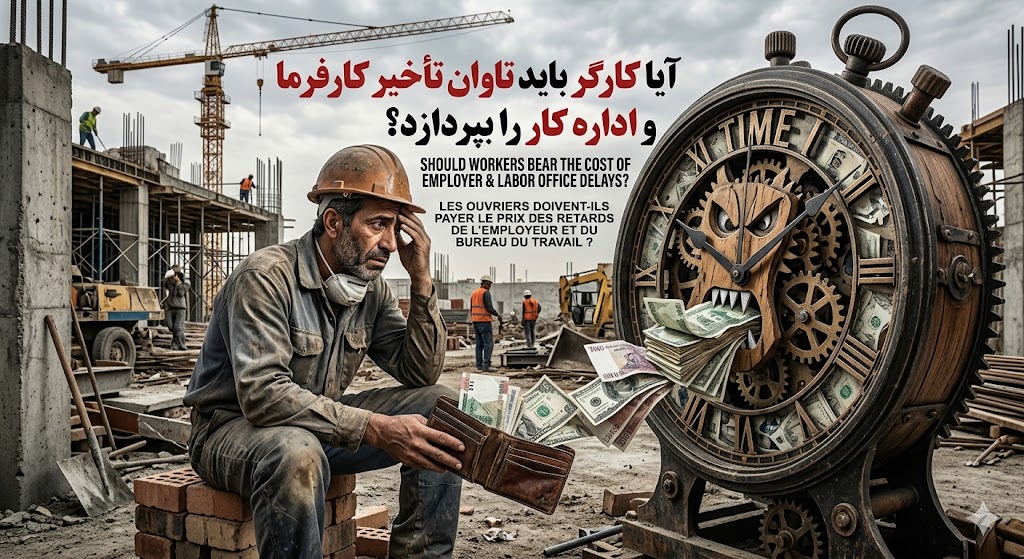
The Labor Department's verdict does not "create" the employer's debt; rather, it "discovers" it. This verdict ultimately confirms that the employer has owed the worker from the very beginning (for example, from the time wages were not paid). Why should the worker pay the price for the employer's delay as well as the delay in the judicial process in which they had no role?
Precedent-Setting Judgment 858 practically allows the employer to trade and profit with the money that is the worker's wage during the review period; but at the time of payment to the worker, they only have to hand over last year's Rial figure.
Conclusion:
Precedent-Setting Judgment 858 was an opportunity to implement justice by confirming the Prosecutor General's opinion and calculating damages from the date of demand. However, the current decision, although it ended part of the dispute, has in practice denied workers true compensation and placed the burden of inflation caused by delayed proceedings on the weakest party in the relationship (the worker). Unfortunately, in this procedure, the violator will profit from their violation. It is hoped that this approach will be reconsidered.
Written by Reza Bastani Namaghi