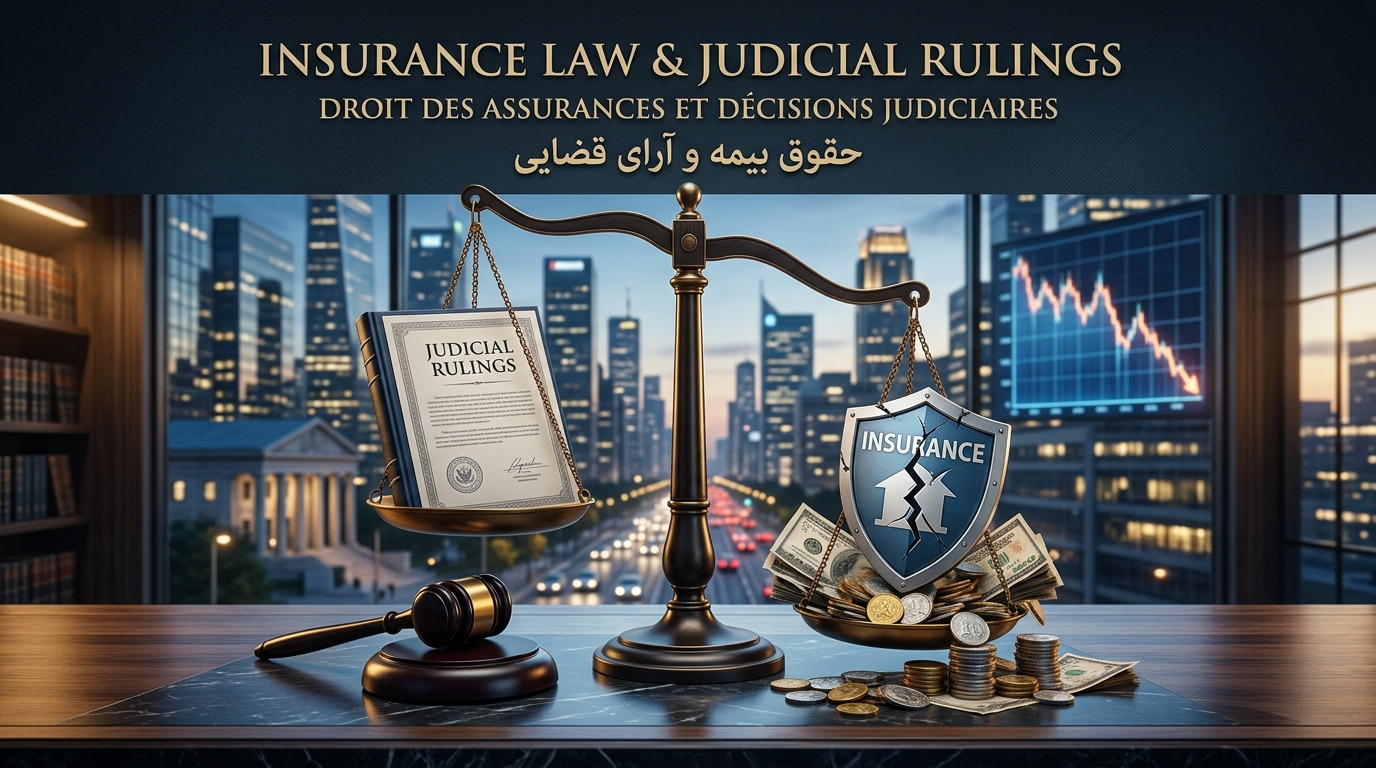
Recently, Unified Judicial Precedent No. 869 was issued by the General Board of the Supreme Court of Iran. This ruling represents an incorrect interpretation of the law that may benefit negligent drivers who injure themselves in the short term. However, in the long run, by imposing financial imbalances on the insurance industry, it will likely harm the general public—similar to past economic crises in Iran—as the government may resort to printing money to cover these massive insurance deficits.
1. What does Ruling 869 say in simple terms?
This ruling mandates that the compensation for an at-fault driver (under Article 3 of the Iranian Compulsory Insurance Law) must be paid at the current daily rate (Yawm al-Ada'), rather than being limited to the ceiling stipulated in the insurance policy.
Context: In Iranian law, bodily injuries are compensated via Diyeh (Islamic statutory compensation or "blood money"), which is updated annually. Under this new ruling, if a driver falls asleep at the wheel, veers off the road, and sustains bodily injuries, the auto insurer is obligated to pay the at-fault driver at the newest, updated Diyeh rate at the time of payment, even if this amount exceeds the maximum ceiling agreed upon in the insurance contract.
https://lnkd.in/d_sae_8u
2. First Critique: Conflating "Accident Insurance" with "Liability Insurance"
Insurance law is fundamentally contractual, meaning the baseline rule is adherence to the policy's ceiling. The Iranian legislator, in Article 13 of the Compulsory Insurance Law, created an exception exclusively for "third parties" (victims), allowing them to be paid above the policy ceiling at the updated daily rate.
However, this exception was balanced by a compensatory mechanism: insurers have the right to claim the difference from the state-backed "Bodily Injury Compensation Fund."
The error in this ruling is extending this mechanism to the at-fault driver. Under the law, the at-fault driver is not considered a "third party," and their coverage is categorized as "accident insurance," not "third-party liability insurance." As a result, the ruling forces the insurer to pay the excess amount, but the law provides no mechanism for the insurer to recover this extra cost from the national Fund!
3. Second Critique: Is the Insurer's Obligation "Diyeh" or "Cash"?
Legally, the obligation to pay Diyeh at the current daily rate falls on the tortfeasor (the person who caused the harm). Ironically, in this scenario, the tortfeasor and the victim are the exact same person. If it weren't for this mandatory accident insurance, there would be no compensable loss at all. The insurer did not cause the harm; their obligation is purely contractual—to pay a specific cash amount in Rials up to a defined limit.
Therefore, the insurer's obligation is a "cash debt," not a direct obligation to pay Diyeh. Consequently, any delay in payment should be calculated based on the general inflation index (as per Article 522 of the Iranian Civil Procedure Code), rather than the newly announced, usually much higher, Diyeh rates. By treating the insurer's contractual cash obligation as Diyeh, this ruling misinterprets its legal nature.
Conclusion:
Ultimately, this ruling means that the cost of an at-fault driver's mistake must be borne first by the insurance industry, and eventually—if these insurers face bankruptcy—by the general public through the national budget (much like the bailouts of defunct credit institutions in Iran's recent history). This is because the ruling:
Places extra-contractual burdens on insurers without providing a mechanism for recovery.
Imposes delay penalties based on the rising costs of Diyeh due to a misinterpretation of the obligation's nature, disrupting the actuarial calculations of insurers who are entirely unprepared to adapt to these new, unpredictable conditions.
Written by Reza Bastani Namaghi
Back to Home
 Read More
 Read More
 Read More
Does Unified Precedent No. 869 Harm the Insurance Industry? A Critical Look at Two Analytical Errors in Iranian Law!
Other Articles & Notes
The Antidote That Arrived After Sohrab’s Death!*
In 2022, along with a group of friends, we filed a petition with the Court of Administrative Justice, arguing that the "...
Banking Policy Transparency in Iran: A Legal Victory for Accessing Central Bank Internal Bylaws
I have always believed that to work effectively, we must first understand the rules of the game and the fundamental prin...
Where is the Ceiling for Liquidated Damages Clauses?
In the Iranian legal system, due to certain difficulties in establishing extra-contractual civil liability—especially re...